Can you complete/compete at the 140.6 distance w/ only 10 hrs of training per week?

Monday, June 13, 2011

What I took from Latta 2011

Three things grabbed my attention most at Latta this year.

The first being the genuine sense of camraderie amongst my athletes. I had the privilege to see a connection between the athletes doning the red, black, and white. It was an awesome sight to see. A special shout out to Logan Cerwin for grabbing an AG win on Saturday!

The second would be how to deal with 'flatness', which can create negative self talk. Isn't it interesting how there seems to be more attention drawn to 'positive' self talk, but rarely the opposite. I knew that this would not be stellar day when I saw the pack of 4 or 5 cyclists gradually pull away from me and fade into the distance. It was at that moment that I had to avoid putting on 'pouty pants', ride my race, and try to stay in the fight. 300 watts was all I could hold and I had to be happy with it. Perry, Woodbury, Forsyth, Haycraft, and Selle raced exceptionally well!

The third was how cool it was to see first timers "toe the line". We have all been there before. Some roll with the MTB, some with a hybrid of some sort, and others will fork out the dough for a legit ride. What I had the privilege to see on Sunday brought me back to how I once approached these events. I remember packing everything I could imagine into a duffle bag that could easily hold my 4 year old son. I remember borrowing a pan from Mom that was large enough to fit two 10 lb turkey breasts (to wash my feet in T1 and probably T2). I remember bringing a towel large enough to cover two of me (to dry my feet). I remember riding my Mongoose Rockadile (for three full seasons) with knobby tires, then slicks, then clip on aerobars. I remember carrying enough PowerBars and Gatorade at the Triangle Triathlon to fuel for Ultraman. This could go on and on. My point is simple. It is refreshing to see that some still represent like I once did. On that particular day I could see the culmination of desire, fear, excitement, cluelessness, and the will to take on a challenge living in hundreds of newbie triathletes. It was an awesome sight to be seen. It was a fresh reminder to me to keep the sport fun.

Enjoy the process friends,
Coach L


Monday, June 6, 2011

Periodization and IML 2011

For those interested in how I am approaching the build toward IML 2011 this post is for you.

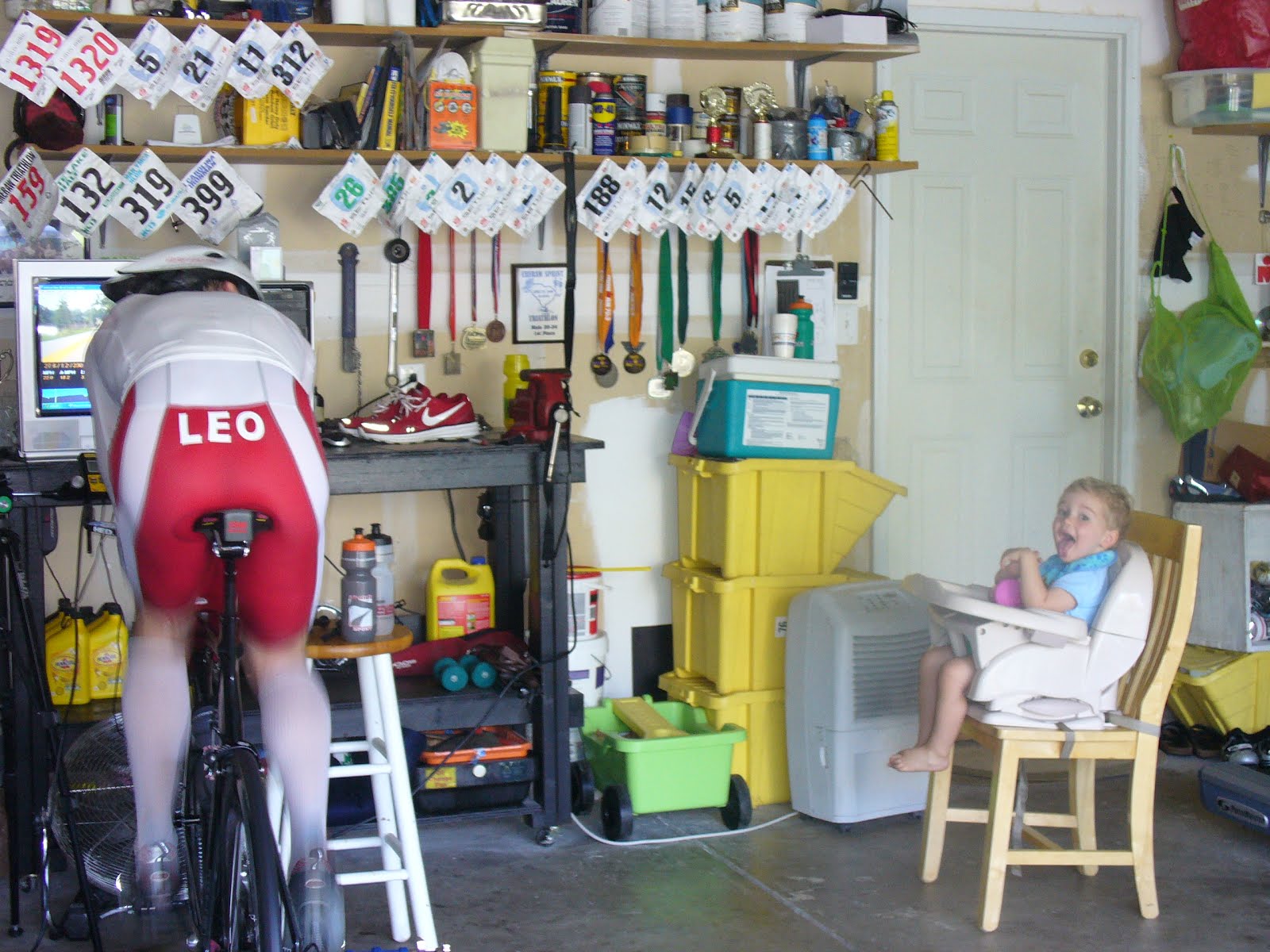
The game plan is to work through 3 mesocyles of 3 weeks in length w/ 1 week of recovery. Currently, I have worked through the first mesocyle. This past Saturday was another high quality session that reflected a 2:40 CompuTrainer ride using the CS 1.6 software. The focal point of these sessions on the trainer are to work the 'sweet spot' (75 to 90%) of my Functional Threshld Power (FTP). Emphasis is being placed on the 250 to 300 watt range for IML 2011 prep.

Here is the fun part friends. I am working both a ladder and pyramid scheme to load the legs within work intervals of 10 to 30+ min in duration. Here is the kicker. To make these 2 to 4 hr sessions equivalent to "112 miles" I add additional stress in acute doses on the back end. On this particular workout I ingested 350 watts x 1 min w/ 1 min recovery. It was fun watching the legs begin to submit to the load; ~90 RPMs decreased to 80 RPMs in 1 min.

What I love about this compressed approach to training is that it mirrors "IM legs" so well. I noted this sensation in a previous post. I always make sure to run post the consumption of such efforts. On this particular day I took on almost 7 miles to test my gut at a pace that would be 30 to 45 sec slower then 1/2 marathon pace (open pacing); 7:10 min/mile average. The entire run I used Gatorade Endurance and mimicked 'aid stations' by ingesting one mouthful of fluid per mile.

For this IM prep I am dialing in on 9 key Endurance Bike/Run workouts. This one was 2 of 9. The plan is to peak at 4 hrs / 1 hr (Bike/Run).

Hoping you are all enjoying the heat and embracing it.

Train smart and with great vigor,
Coach L

This last sentence is important. I recommend you take note of how much fluid your mouth can take in. This knowledge will allow you to best strategize for your fluid/energy intake on race day and while training.

Wednesday, June 1, 2011

DSL or Dial Up?

Most of you reading this post will remember the days of Dial Up. The time it took to connect to the web could test the most mild mannered soul. Today its ridiculous how quick one can navigate from one URL to the next.

I open this post with reference to DSL and Dial Up to hammer home a very important point when running. Most athletes spend much time and energy to get faster. I can't blame them for that. We all want to get faster.

Some will even focus on running form and economy to make the 'cost' of running less. I'd argue, however, that most default to pushing the pace harder with little attention to the neurological end of things.

Case in point. When going to the track and doing 6 x 800 m to 4 x 1600 m efforts what are you looking at for the most part? Your splits? Your HR response? Your blood lactate accumulation? Your stride rate tendencies? What metrics are you looking at?

Lets bring this closer to home. Today I ventured out on my 1.35 mile loop to hit 10 miles at 1/2 marathon pace. On this run I focused on holding a steady pace all the while focusing on the all important stride rate. For me a stride rate of 90 to 92 per minute is indicative of a pace of 5:45 to 6:05. On the flip side, when I switch from DSL to Dial Up (fatigued nervous system) I see stride rate ranging from 84 to 85. This stride rate tends to point to a pacing that mirrors a 6:45 to 8:10 pace.

Take Home Point: when an athlete gets fatigued (neurologically and muscularly) they will spend more time on the ground (per foot strike) vs. going forward. Stride rate typically decreases and pace increases. Two things that people do not want to happen when racing.

At IMF 2010 my average pace was 8:10/mile with an average stride rate of 82 (including walk breaks at aid stations). I'd be willing to bet that if I had trained my legs to turnover at 88 to 90 (two knee surgeries prevented much training at all) that pace would have been closer to 7:30/mile.

Okay, lets get to the point. If an athlete wants to get faster at short to long course racing he or she better focus on increasing their ability to resist fatigue at the neurological end of things.

Yes, its important to log fast 1600s, 400s, 800s, etc, but one MUST not forget about the HOW and the WHY behind their training progressions.

I hope you all focus on 'upgrading to DSL' in 2011 and beyond.

I'll be sharing how I am making such an uprgade in posts to come.

Train with purpose, train with precision, and train smart,
Coach L